
You cannot reliably check if honey is pure at home. Popular tricks such as the water test, flame test, thumb test and paper test measure thickness and moisture, not purity, so real honey can fail them and syrup-blended honey can pass. The dependable checks are a complete label, a seller who stands behind the batch, and a laboratory test against the FSSAI honey standard.
This guide explains what each home test shows, what to look for on the jar, and how labs detect adulteration.
How to test if honey is pure at home
Here are the common home tests, what people believe they show, and what they really measure.
| Home test | The claim | What it really shows | Reliable? |
|---|---|---|---|
| Water test | Pure honey sinks and stays in a lump | Thickness and water content | No |
| Flame or matchstick test | Pure honey lets a dipped wick burn | Moisture level; syrups burn too | No, and a fire risk |
| Thumb test | Pure honey stays put on the thumb | Thickness, which changes with temperature and flower source | No |
| Paper or tissue test | Pure honey does not soak through | Water content | No |
| Fridge or crystallisation check | Pure honey crystallises | Glucose to fructose balance and temperature | No; some pure honeys stay liquid |
| Taste and smell | Real honey has a floral aroma | Flavour, which varies widely | A rough hint only |
Modern adulterants, such as specially processed rice or sugar syrups, are designed to match honey's thickness and behaviour. That is why these tricks often fail to catch them.
Why home tests give wrong answers
Honey is a natural product, and genuine honeys differ a lot. Water content, flower source, season and storage temperature all change how honey looks and flows.
- Acacia honey is naturally runny and slow to crystallise, so it can "fail" the thumb and water tests while being perfectly genuine.
- Multiflora and mustard honeys often crystallise quickly in winter, which some people wrongly take as a sign of added sugar.
- Honey from humid regions may have slightly more moisture and dissolve faster in water.
A pass or fail at home does not prove anything either way. Use these tests out of curiosity, not to judge a brand.

What does "100% pure honey" mean on a label?
It should mean the jar contains only honey, with no added sugar, syrup, colour or flavour. The phrase itself is a claim by the seller; what backs it up is the rest of the label and the seller's willingness to share test results.
When you buy packed honey in India, check that the label shows:
- The product name as "honey", and the flower source if it is a single-flower honey.
- Ingredients: honey only. Anything else means it is a honey product or blend.
- The FSSAI licence number and the manufacturer or packer's name and address.
- Net weight, batch or lot number, and the date of packing or best before date.
- Storage advice, which usually mentions that natural crystallisation can happen.
A missing licence number, no batch code or a vague address is a stronger warning sign than any kitchen test.
How labs check honey purity
The FSSAI standard for honey sets limits for a range of parameters. Accredited food labs test honey for things such as:
- Moisture: too much water can mean the honey was harvested early or diluted.
- Sugar profile: the levels of fructose, glucose and sucrose, and their ratio.
- HMF (hydroxymethylfurfural): a compound that rises when honey is overheated or stored badly.
- Markers for added syrups: tests for cane or corn sugar (C4 sugar) and specific markers for rice syrup.
- Pollen: pollen analysis helps confirm the flower source and that the product is honey.
Some labs also use NMR profiling, which compares a sample against a database of genuine honeys. A single test is rarely enough; labs combine several.
If purity matters a lot to you, ask the seller whether they can share a test report for the batch you bought.
Is crystallised honey fake?
No. Crystallisation is a natural process in which glucose forms crystals, and it happens faster in cool weather and in honeys with more glucose. Crystallised honey is safe to eat.
To make it runny again, stand the closed jar in warm (not boiling) water for a while. Our guide on why honey crystallises explains this in more detail.
Does clear honey mean purer honey?
No. Clarity depends on the flower source and how finely the honey was filtered. Very clear honey may simply be filtered more; slightly cloudy honey may contain more pollen. Neither tells you whether syrup was added.
Practical buying tips
- Buy from sellers who print a full label and answer questions about sourcing.
- Be cautious of honey that is much cheaper than the market rate for its type.
- Choose the flower source you like by taste; do not expect a particular texture to prove purity.
- Store honey closed, away from sunlight and heat.
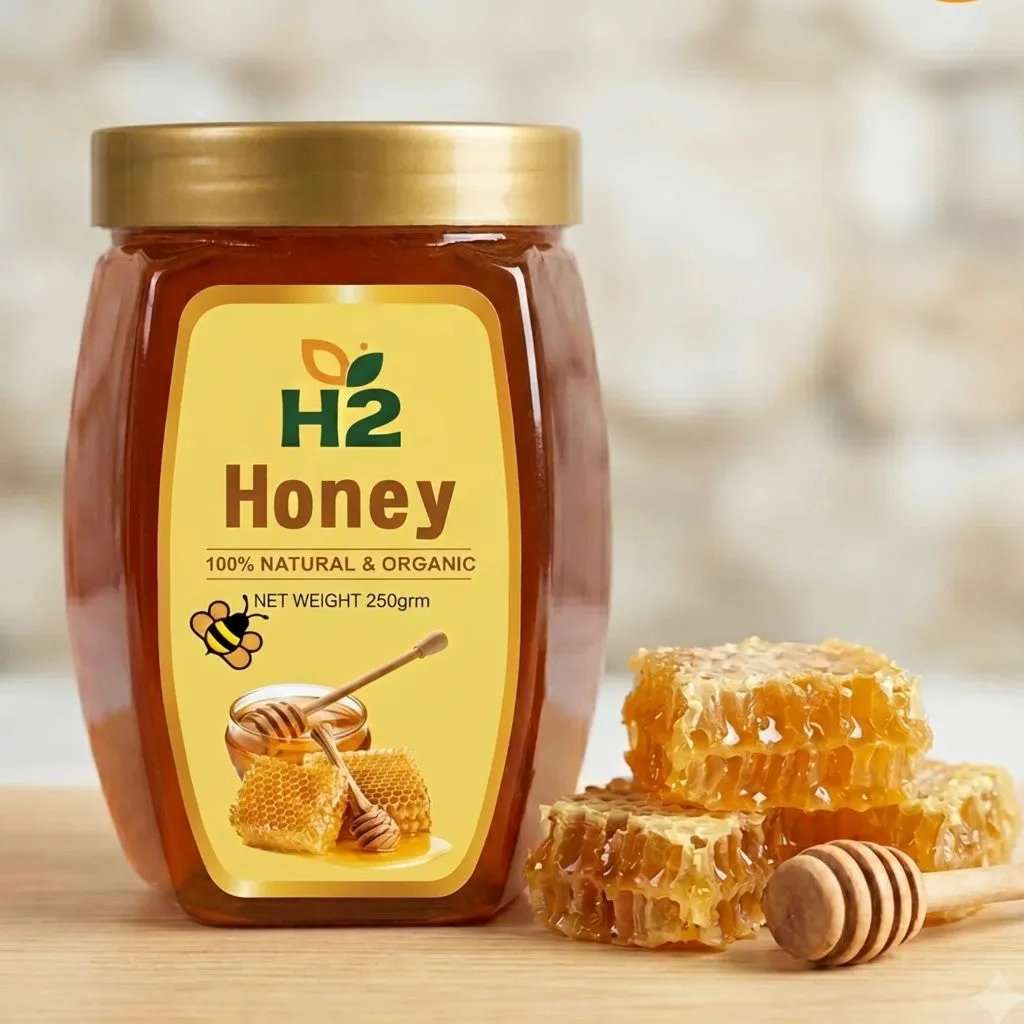
You can see the full labels and pack sizes for each jar in our honey collection. For everyday use, HTWO Multiflora Honey starts at ₹215 for 250g.
Key facts
- Water, flame, thumb and paper tests cannot prove honey is pure.
- A complete label with an FSSAI licence number and batch code is the first real check.
- Labs test moisture, sugar profile, HMF, syrup markers and pollen.
- Crystallisation is natural and is not a sign of fake honey.
- No honey for babies under 12 months, whatever its purity.
Frequently asked questions
How do I know if my honey is real?
Check the label for "honey" as the only ingredient, an FSSAI licence number and a batch code, and buy from a seller you trust. Only a lab test can confirm purity.
Does pure honey dissolve in water?
Yes, eventually. All honey dissolves in water when stirred. How quickly it disperses depends on its thickness and moisture, not on purity.
Is the flame test safe or accurate?
It is neither. It mainly shows how much water the honey holds, syrups also burn, and it is a fire risk in the kitchen.
Can I get my honey tested?
Yes. FSSAI-notified and NABL-accredited food testing labs in many cities test honey for a fee. Ask for testing against the FSSAI honey standard.
Why does my honey have foam on top?
A thin layer of foam can form from tiny air bubbles trapped during bottling, especially in thicker honey. It is usually harmless. If the honey smells sour or fizzy, it may have absorbed moisture and fermented, so stop using it.



0 comments