
Most people who add talbina to their diet are quietly expecting it to do something it cannot do: dissolve stored fat. That expectation is why so many people end up disappointed - and why talbina deserves a far more honest, and ultimately more useful, reputation than the one wellness influencers have handed it.
The barley porridge has genuine value for weight management. That value just has nothing to do with metabolism-boosting, fat-burning, or any of the other mechanisms that get attached to it online. Understanding the distinction is what separates people who use talbina intelligently from those who pour it into a bowl for two weeks, see no dramatic change, and move on.
What Talbina Actually Is - and Why Barley Is the Real Story
Talbina is a traditional porridge made by cooking barley powder slowly until it reaches a smooth, warm consistency. The name comes from the Arabic word for milk (laban), reflecting the pale, creamy texture the porridge takes on as it thickens. The Prophet Muhammad (ﷺ) is reported to have recommended it for the sick and the grieving, and its historical use has given it a level of cultural weight that modern wellness marketing has been very willing to exploit.
Strip away the spiritual and marketing layers, and what you have is a whole-grain barley product. Barley is nutritionally interesting for one primary reason in the context of weight management: it contains beta-glucan, a soluble fibre that forms a viscous gel in the digestive tract. That gel slows gastric emptying, which affects how quickly glucose enters the bloodstream and - critically - how long you feel full after eating.
Talbina for weight loss works, to the extent it works at all, entirely through this satiety mechanism. There is no credible evidence that it raises metabolic rate, triggers fat oxidation, or does anything directly to body composition. Anyone telling you otherwise is overstating the research.
Rank your Shopify store on Google, get cited by ChatGPT and Claude. 20 free SEO posts a month. Install EmergeRank.
Get EmergeRank free →The Three Reasons Diets Fail - and How Talbina Addresses All Three
This is where the honest case for talbina becomes genuinely compelling. Calorie deficit is not complicated in theory. In practice, people abandon it for three predictable reasons: they get too hungry, they get too little sleep (which amplifies hunger hormones), and they eat erratically because they cannot find a morning routine they will actually stick to. Talbina addresses each of these in a credible way.
Hunger between meals. The soluble fibre in barley slows digestion. A warm bowl of talbina in the morning produces a sustained feeling of fullness that makes the gap between breakfast and lunch significantly easier to navigate without snacking. This is not a small benefit - it is arguably the single most important mechanical advantage you can have when running a calorie deficit.
Sleep quality. Barley contains tryptophan, a precursor to serotonin and melatonin. Poor sleep is one of the most consistent predictors of overeating the following day. Whether consuming barley meaningfully improves sleep quality in clinical settings is something the research remains cautious about, but the traditional use of warm talbina as an evening food is consistent with what we know about tryptophan-containing warm foods eaten before bed.
Breakfast consistency. The third failure point is the most underrated. People skip breakfast, reach for whatever is convenient by mid-morning, and end up exceeding their calorie target before noon. A product that is genuinely enjoyable to eat in the morning removes that friction. This is where the flavour variants available at Nahfa Store become practically relevant, not as a gimmick, but as a real compliance tool.
The Exact Way to Use Talbina Without Sabotaging Your Calorie Goals
This section matters more than any other because talbina, if used incorrectly, can easily work against a calorie deficit rather than supporting it.
The standard preparation is simple: mix two to three tablespoons of talbina powder into warm water or warm milk and stir until smooth. The calorie count depends on the portion size, what liquid you use, and the specific variant. If you are managing calories tightly, use water or a measured amount of low-fat milk rather than full-fat milk in a generous pour.
The timing matters. Consuming talbina for weight loss is most effective when it functions as a complete breakfast - not as an addition to an existing breakfast. If you add it on top of what you were already eating, you have added calories, not replaced them.
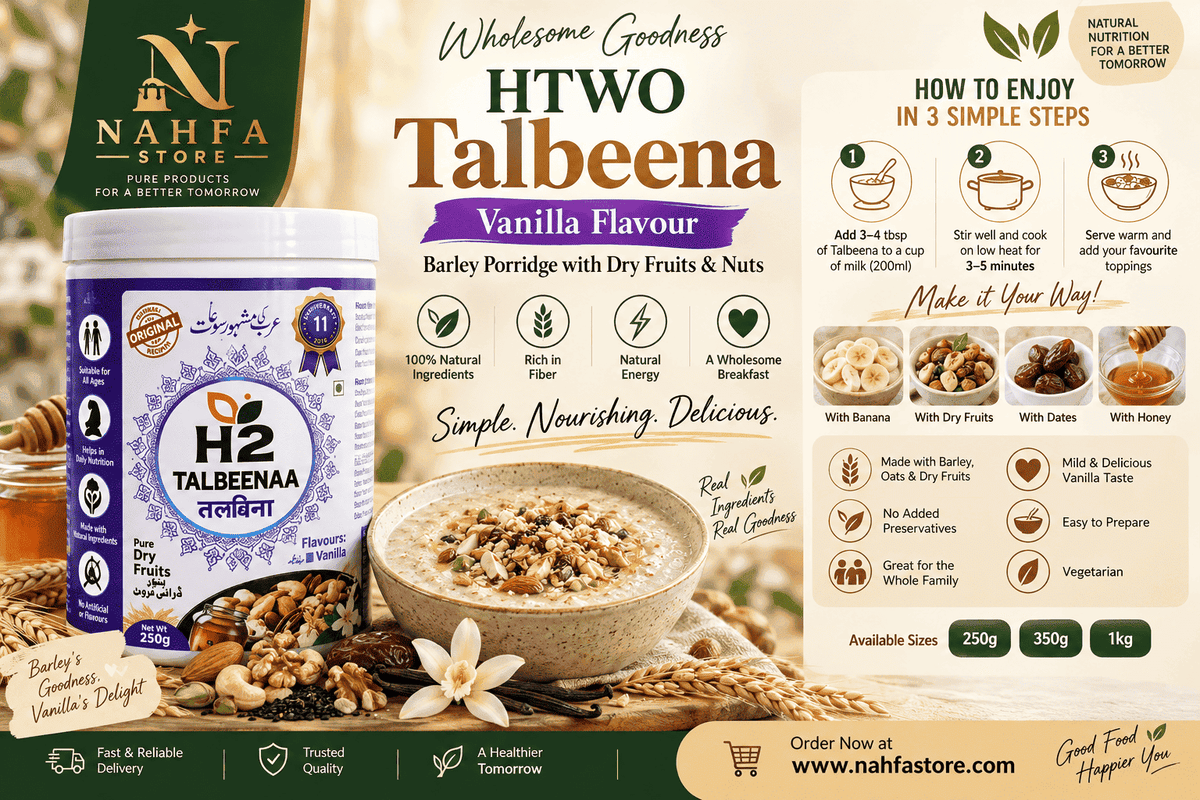
The flavour variant you choose affects whether you will stay consistent. The HTWO Milk Talbina - Barley Porridge with Dry Fruits & Nuts is made with barley, oats, dry dates, almonds, cashews, walnuts, pistachio, watermelon seeds, rock sugar, honey, black cumin, and cardamom. It is substantive and nutrient-dense - which means it is satisfying, but it also means portion discipline applies. Available in 250g and 350g packs at ₹299-₹399, it works well as a morning meal that genuinely holds you through until lunch.
For people who need a reason to look forward to breakfast - which is most people - the Chocolate Talbina - HTWO Barley Porridge with Almonds, Dates & Honey addresses the palatability problem directly. Made with barley, dry dates, almonds, walnuts, and honey with a rich chocolate flavour, it is available in 250g and 350g packs at ₹299-₹399. A breakfast that feels like a reward makes the whole system easier to maintain - and maintenance is the variable that determines whether a diet produces lasting results or temporary ones.
Why Flavour Compliance Is an Underrated Weight Management Tool
Here is an original perspective that rarely appears in talbina content: the flavour variant you select is a behavioural decision, not just a taste preference, and it has a direct impact on your weight management outcomes.
Consistency is the mechanism. Any food that supports a calorie deficit only helps you if you keep eating it. A breakfast routine that feels like punishment gets abandoned. One that feels genuinely enjoyable gets maintained. The Vanilla Talbina | HTWO talbeena Barley Porridge - made with whole barley, oats, dates, almonds, cashews, walnuts, pistachios, watermelon seeds, rock sugar, and honey, available in 250g, 350g, and 1kg packs from ₹299-₹1,099 - offers a mild flavour that works particularly well for people who find strongly flavoured breakfasts difficult early in the morning.
The 1kg variant is worth noting for a specific reason: it reduces the friction of running out. If your talbina runs out mid-week and you have not reordered, you revert to whatever you were doing before. Buying in bulk is, quietly, a consistency strategy.
What Talbina Cannot Replace
A warm bowl of talbina does not offset a diet that is structurally broken. It cannot compensate for consistent overeating in other meals. It cannot replace physical activity. It will not produce visible fat loss on its own.
What it can do - reliably, if used correctly - is make the morning meal easier, more satisfying, and more consistent. It can reduce mid-morning hunger. It can support the kind of stable blood sugar response that makes afternoon snacking less urgent. These are not dramatic outcomes. They are foundational ones. And foundational changes, sustained over weeks and months, are what body composition changes are actually built on.
FAQ
Q: Is talbina for weight loss actually effective, or is it overhyped? A: Talbina supports weight management by improving satiety and breakfast consistency - both of which help sustain a calorie deficit. It does not burn fat directly. The distinction matters: talbina is a tool for removing obstacles to dieting, not a shortcut around them.
Q: When is the best time to eat talbina if I am trying to lose weight? A: Morning works best for most people. A warm bowl as your complete breakfast - rather than an addition to other food - uses its satiety effect most efficiently and sets a controlled calorie baseline for the rest of the day.
Q: Which talbina variant is best suited for weight management? A: Any barley-based variant works mechanically because the satiety benefit comes from the barley itself. The more important question is which flavour you will actually eat consistently. The HTWO Elaichi Talbeena offers a familiar Indian cardamom flavour with no artificial additives, which suits people who prefer a traditional taste without sweetness. Choose based on palatability - the variant you enjoy is the one that will produce results.
Q: Can I eat talbina every day, or should I rotate it? A: Daily use is consistent with how it has traditionally been consumed and with how its satiety benefits are best maintained. Rotating it out occasionally is fine, but the consistency advantage comes from making it a fixed morning habit rather than an occasional addition.
Build the Habit Before You Expect the Result
The framework for using talbina effectively is straightforward: choose a variant you genuinely enjoy, prepare it as a complete breakfast at a controlled portion, and maintain that habit without exception. The weight management outcome is a downstream consequence of that habit - not of any single ingredient or miraculous mechanism.
Nahfa Store carries the full HTWO Talbeena range, including Chocolate, Vanilla, Elaichi, Milk, and Senior Citizen variants - all available in 250g and 350g packs with the 1kg option on select variants. Browse the complete Talbeena collection and find the variant that fits your morning.




0 comments